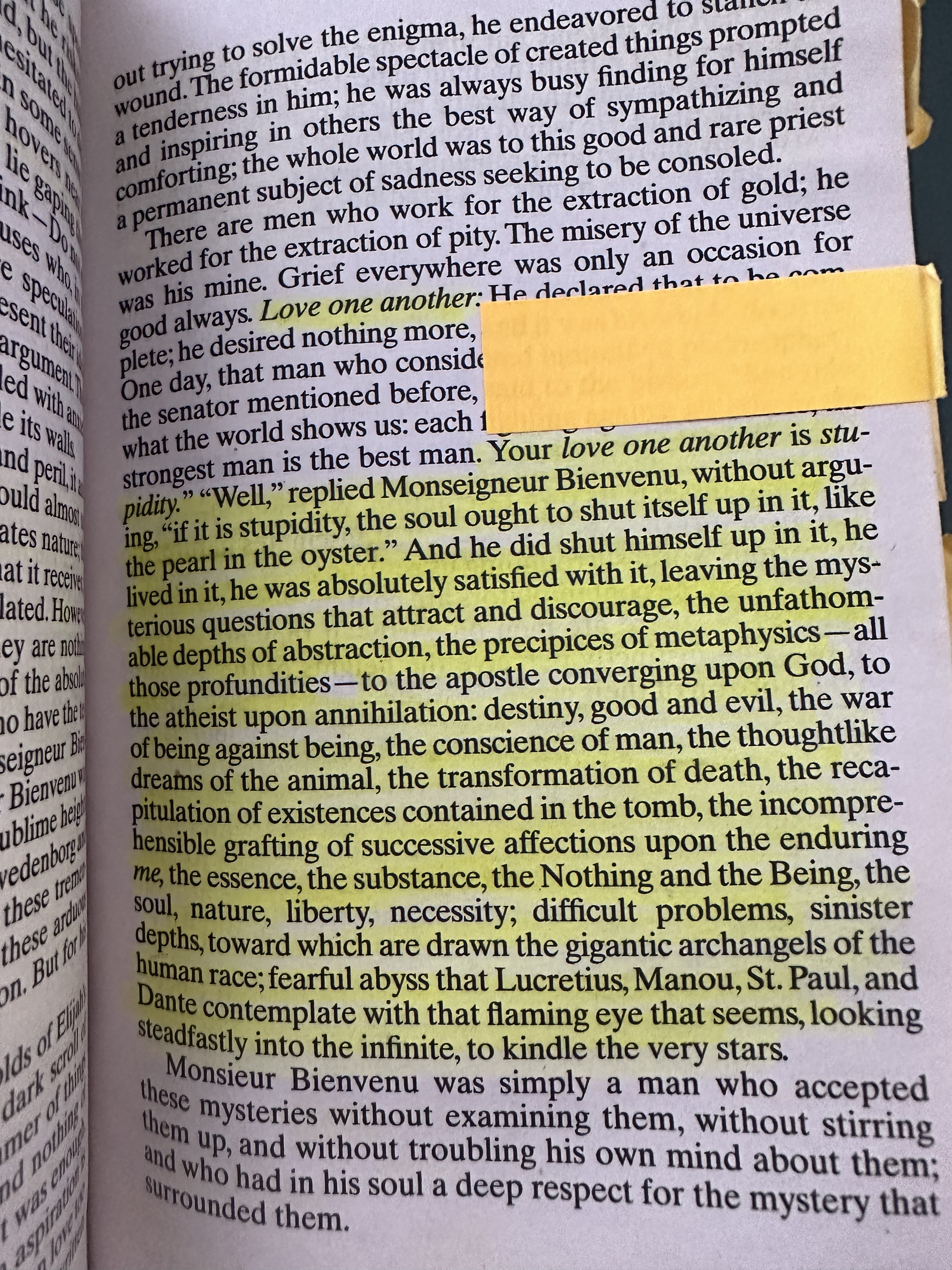
My journey through the literary masterpiece Les Misérables by Victor Hugo has been nothing short of magnificent. Although I am about 75% through, his writing, romantic and kissed with sentience of the 19th century zeitgeist of Paris, France, is poignant and compelling even in his characters’ sufferings.
This book has been opened on:
sunny days at my childhood home in a swimming pool full of dancing light, with the melody of songbirds in love,
an alcove with a window greeting the gentle hellos of the Gulf of Mexico,
a beach hugging glass waters ablaze by the sun’s rapture — hot enough to set the pages on fire,
chilly nights in the midwest with the sound of tree branches whispering on the wind,
The list goes on. It’s been tarnished and torn on beaches and boats, in cars and planes, at the bottom of bookbags and duffels, through bliss and anguish, all with a lover’s grip of tenderness and longing, unable to part.
Page 54-55
“He was out there alone with himself, composed, tranquil, adoring, comparing the serenity of his heart to the serenity of the skies, moved in the darkness by the visible splendors of the constellations and the invisible splendor of God, opening his soul to the thoughts that fall from the Unknown. In such moments, offering up his heart as the flowers of night emit their perfume, lit like a lamp in the center of the starry night, expanding in ecstasy the midst of creation’s universal radiance, perhaps he could not have told what was happening in his own mind; he felt something floating away from him, and something descending upon him, mysterious exchanges of the soul with the universe.
He contemplated the grandeur and the presence of God; the eternity of the future, that strange mystery; the eternity of the past, a stranger mystery; all the infinities hidden deep in every direction; and, without trying to comprehend the incomprehensible, he saw it. He did not study God; he was dazzled by him. He reflected on the magnificent union of atoms, which gave visible forms in Nature, revealing forces by recognizing them, creating individualities in unity, proportions in extension, the innumerable in the infinite, and through light producing beauty. These unions are forming and dissolving continually, from which come life and death.”
Page 57
 NIKKI BYRD — writer, thinker, lover
Leave a comment