Note: This content was written entirely by me and was not generated, edited, or researched using AI.
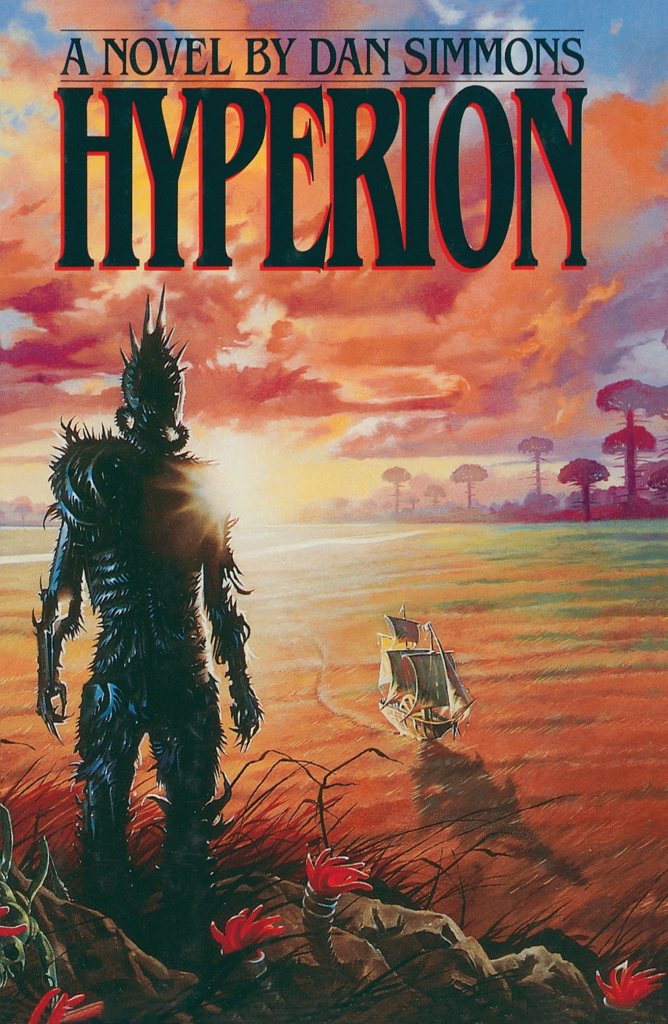
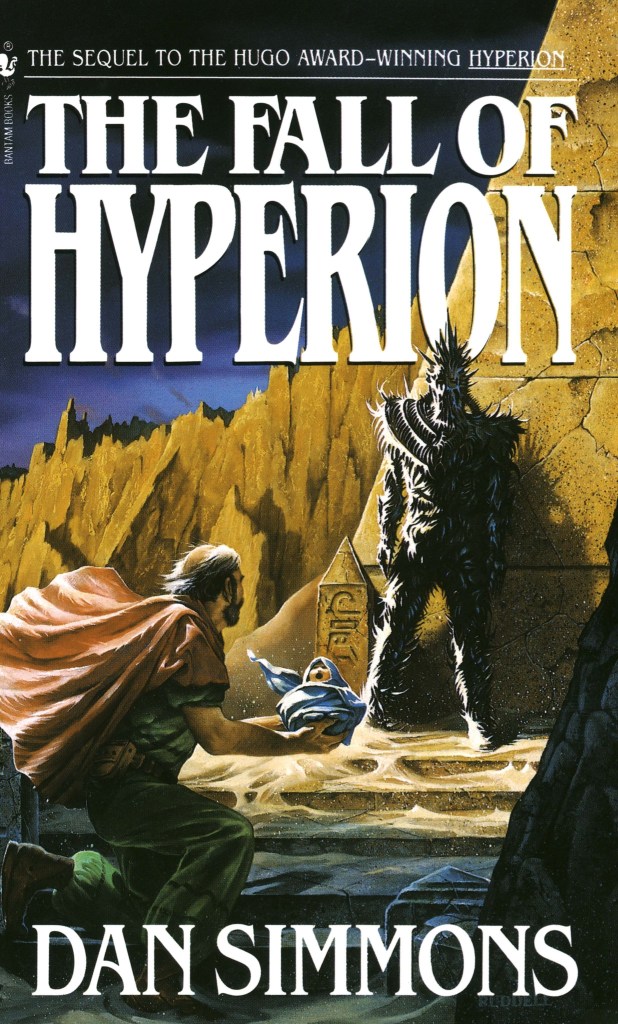
Length
Hyperion: 483 pages
The Fall of Hyperion: 528 pages
Genre
Science Fiction
Difficulty
Intermediate / Difficult*
It is always daring to pick up a sci-fi, as we hope it does everything right; the world-building as to not be so difficult, but engaging, the elements of the future (if they are utilized) both cogent and enjoyable, and characters, even if not human, are relatable and evocative. And to top it off, the theme and elements MUST remain recursive and consistent throughout the story. A classic, an original, Hyperion does just that.
The Consul
Lenar Hoyt, the priest
Fedmahn Kassad, the soldier
Martin Silenus, the poet
Het Masteen, the Templar
Sol Weintraub the scholar, along with his daughter Rachel
Brawne Lamia, the detective
This concludes the group of pilgrims chosen by the Church of Final Atonement to journey to the Time Tombs in a valley on the unpredictable variable—the planet Hyperion. Simmons wields a vivid, intergalactic empire known as the WorldWeb, over 200 planets connected by farcasters and governed by the Hegemony of Man, empowered by the TechnoCore (AIs) and guided by a human digital democracy, the All Thing.
Simmons gives dimension to all the pilgrims in Hyperion, the first book of the series. We have seven strangers meeting on Het Masteen’s ship, the Yggdrasill, as they head toward the outback planet of Hyperion. There, they agree to tell the tales of their lives, as they all try to ascertain the reasoning behind why they were chosen for the pilgrimage to kill the Avatar, Angel of Final Atonement, Angel of Retribution, Lord of Pain—the Shrike.
“The cruciform does not like pain. Nor do I but, like the cruciform, I am willing to use it to serve my purposes. And I will do so consciously, not instinctively like the mindless mass of alien tissue embedded in me. This thing only seeks a mindless avoidance of death by any means. I do not wish to die, but I welcome pain and death rather than an eternity of mindless life. Life is sacred—I still hold to that as a core element of the Church’s thought and teachings these past twenty-eight hundred years when life has been so cheap—but even more sacred is the soul.” [Hyperion]
This ship is only one of the many milieus that strike us as the pilgrims travel through the City of Keats, to the river barges pulled by mantas and windwagons sailing through the Sea of Grass, to reach the Time Tombs where the Shrike is trapped in the anti-entropic fields, manipulating time through the valley.
Let it be said that Hyperion offers nothing short of an adventure, and Simmons, with his interpretative literary steering, allows all of elements of his world—EMVs, skimmers, the Hawking Drive, Hawking Mat, farcasters, cybrids, holies, datumplane, Schrön loop, and more—to be understood, refraining from intellectual elitism, so that even a beginner can enjoy the use of these scifi elements.*
The Fall of Hyperion, succeeding Hyperion, focuses more on the adventures of the pilgrims and other characters after they reach the Time Tombs in search of the Shrike. The fragmented narrative jumps from person to person and place to place, allowing the reader to bear witness to the Shrike’s intergalactic omnipresence and otherworldly, futuristic power after its release from the Tombs.
This sci-fi explores various imagined technologies in these interstellar adventures, the reader’s visitation not limited to the planets themselves, but also the datumplane where analog personas encounter phages, tapeworm viruses, and dimensions of information, an environment both occupied by the TechnoCore and humans.
We also get the pleasure to glimpse into enigmatic factions of the galaxy cursorily mentioned in Hyperion, such as the Templars, the Shrike Church, Ousters, and even AIs (with the honorable mention of the Bikura, examined thoroughly in the first book). These factions weave themes of religion, nature, technology, and the human condition throughout the foundation of this space opera, gripping the reader while also eliciting deeper contemplation of the same mysteries and concerns still relevant today.
“Sek Hardeen’s perfectly modulated, softly accented tones showed a hint of agitation. ‘We [humans] have spread out through the galaxy like cancer cells through a living body, Duré. We multiply without thought to the countless life forms that must die or be pushed aside so that we may breed and flourish. We eradicate competing forms of intelligent life.’” [The Fall of Hyperion]
*Although this book can be beginner friendly, I’ve rated it ‘intermediate’ as beginners may have a hard time grasping some sci-fi elements.
★★★★
SYNOPSIS
Hyperion
On the world called Hyperion, beyond the reach of galactic law, waits a creature called the Shrike. There are those who worship it. There are those who fear it. And there are those who have vowed to destroy it. In the Valley of the Time Tombs, where huge, brooding structures move backward through time, the Shrike waits for them all.
On the eve of Armageddon, with the entire galaxy at war, seven pilgrims set forth on a final voyage to Hyperion seeking the answers to the unsolved riddles of their lives. Each carries a desperate hope—and a terrible secret. And one may hold the fate of humanity in his hands. Read More / Buy Now
The Fall of Hyperion
The shadow of war has fallen on the Web. In the corridors of power on Tau Ceti Center, chaos reigns. Out of reach from the clashing empires, the artificial intelligences of the TechnoCore manipulate everyone and everything. And on Hyperion itself, where battle rages in the skies and on the streets, the mysterious Time Tombs are opening. And the secrets they contain mean that nothing—nothing anywhere in the universe—will ever be the same. Read More / Buy Now
 NIKKI BYRD — writer, thinker, lover
Leave a comment